BLOG

- Home
- Blog
- Technology
- Relay Buying Guide: 9 Steps to Choose the Right Product
Relay Buying Guide: 9 Steps to Choose the Right Product
December 17,2025

Relay Selection Guide: 9 Steps to Choose the Right Product
How to choose a relay? Master these 9 key steps to easily select the right product for your needs:
1. Select Product Category
In & Out relay codes start with letters, corresponding to different application scenarios:
- A: Automotive Relays, suitable for various automotive equipment
- C: Air Conditioning/High Power Relays, suitable for solar panels, industrial control
- E: EV Relays, dedicated to electric vehicle industry, high-voltage devices
- G: Power/General Relays, suitable for household appliances, smart home, toys
- N: New Energy Relays, suitable for photovoltaic field
- H: High Current/Industrial Control Relays, suitable for solar panels
- L: Latching Relays, suitable for smart electricity meters
- P: MOS Relays
- S: Slim Industrial Control Relays
- T: Signal Relays, suitable for communication equipment, office equipment
2. Confirm Operating Voltage
Distinguish between Alternating Current (AC)/Direct Current (DC), corresponding voltage ranges:
- DC: 3~110VDC
- AC: 5~230VAC
3. Select Contact Configuration
Choose according to circuit on/off requirements:
- 1A, 1B, 1C, 2A, 2B, 2C
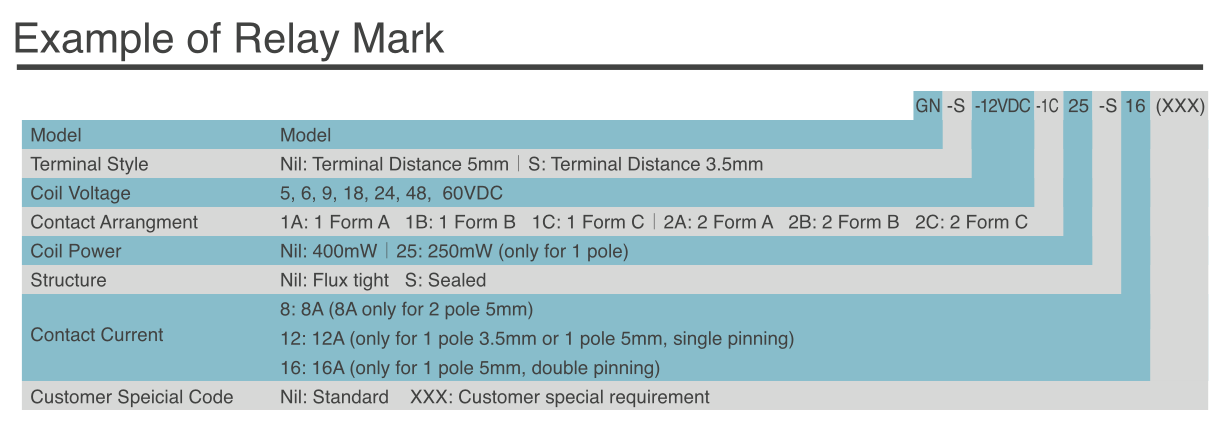
4. Match Coil Power
Different codes correspond to different power levels:
- Nil: Standard regular products
- 25: 250mW
- 36: 360mW
- 40: 400mW
5. Confirm Contact Current
Select according to current carrying requirements:
- 8: 8 Amperes, 12: 12 Amperes, 16: 16 Amperes
6. Select Suitable Terminals
- Terminal pitch or type varies by product model; select the one matching your circuit board specifications.
7. Determine Packaging Type
- Plastic-sealed type: For environments with potential contamination or dust
- Solder-resistant type: For clean environments
8. Choose Contact Material
- Common contact materials for In & Out relays: AgSnO₂ / AgNi / AgCdO; gold-plated contacts are optional for some models to meet higher conductivity requirements.
9. Special Specification Marking
- Special customized specifications or customer-specific codes will be marked at the end of the product model.